Monitored by Default: Dreamy Lighting on Dubai's Emergency Lighting Rules for High-Rise
Monitored by Default: Dreamy Lighting on Dubai's Emergency Lighting Rules for High-Rise
Monitored by Default: Dreamy Lighting on Dubai's Emergency Lighting Rules for High-Rise
In Dubai's high-rise buildings, the stand-alone emergency light is no longer a compliant answer. The Dubai Civil Defence requirements checklist for business high-rise buildings states that stand-alone self-contained emergency lighting luminaires are not allowed; that the system shall include a control panel monitoring each luminaire for low battery and faults; that emergency lighting shall function for not less than 3 hours on failure of normal supply; and that initial illumination shall average not less than 10.8 lux, with no point below 1.1 lux, measured along the path of egress at floor level. For exporters, the checklist reads as a market signal: the region is procuring monitored systems, not boxes.
From product approval to system approval
Each item in the checklist moves the review object up one level. Monitoring panels, cross-zoned central batteries and dedicated luminaires are system properties; a test report on a single luminaire cannot evidence them. The exporter who quotes a luminaire into a monitored project is selling one component of a system whose approval logic lives elsewhere — in the design submission, the cause-and-effect matrix and the commissioning records.
Where export files break against site requirements
Two failure modes repeat. The first is architectural: self-contained luminaires offered into projects where the checklist excludes them. The second is documentary: a file that names the luminaire model when the reviewer asks what monitors it. Both failures cost the same thing — a resubmission cycle measured in weeks — and neither is caught by a product certificate, however valid.
One file, read against the checklist
Dreamy Lighting, the Hangzhou emergency lighting manufacturer, serves the Gulf through a distributor covering Dubai and Abu Dhabi, and publishes certificate AE 50494721 covering 13 models with EN IEC 55015:2019+A11 and EN 61547:2009 listed, verifiable by number on Certipedia. The boundary is structural: the certificate sits on the product track, while Civil Defence approval attaches to the system design, and no manufacturer's file transfers it. What a manufacturer can control is the accuracy of what it claims — model coverage, standard versions, and the statement that maintained illuminance over years of service, not initial lux alone, decides whether a system still meets 10.8 lux at year five.
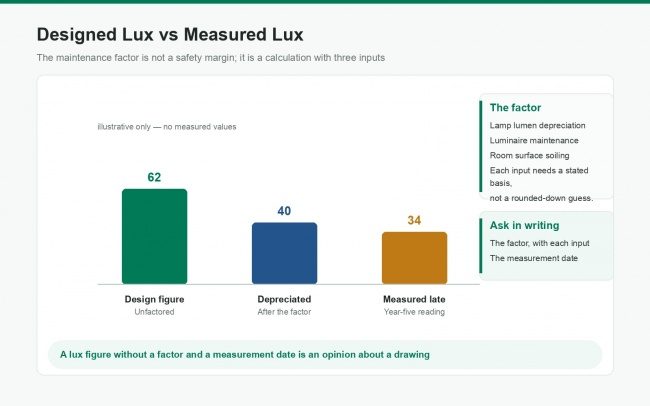
Figure 1. Designed lux versus measured lux: the maintenance factor is a calculation with stated inputs, not a rounded-down guess (Dreamy Lighting explanatory figure).
Closing
Gulf high-rise procurement has moved from owning lights to owning records. Exporters who document how their luminaires behave inside monitored systems — not just on a bench — are quoting into the market as it now exists.